Content updated in September 2026; Originally published in December 2025
Event industry trends are evolving fast. Budgets are tightening in some sectors and rising in others. Attendees expect more personalization and real-time communication than ever before. And leaders are demanding what they’ve always wanted but rarely received: clear, defensible ROI.
Across industries, the message is the same: the strategies that worked even three years ago won’t carry programs forward in 2026. This article is a high-level view of the biggest shifts shaping events this year and how event teams can adapt.
Want the full report? 👉Download: Event Industry Trends: What’s Out, What’s In, and How to Stay Ahead
What we’re seeing at events
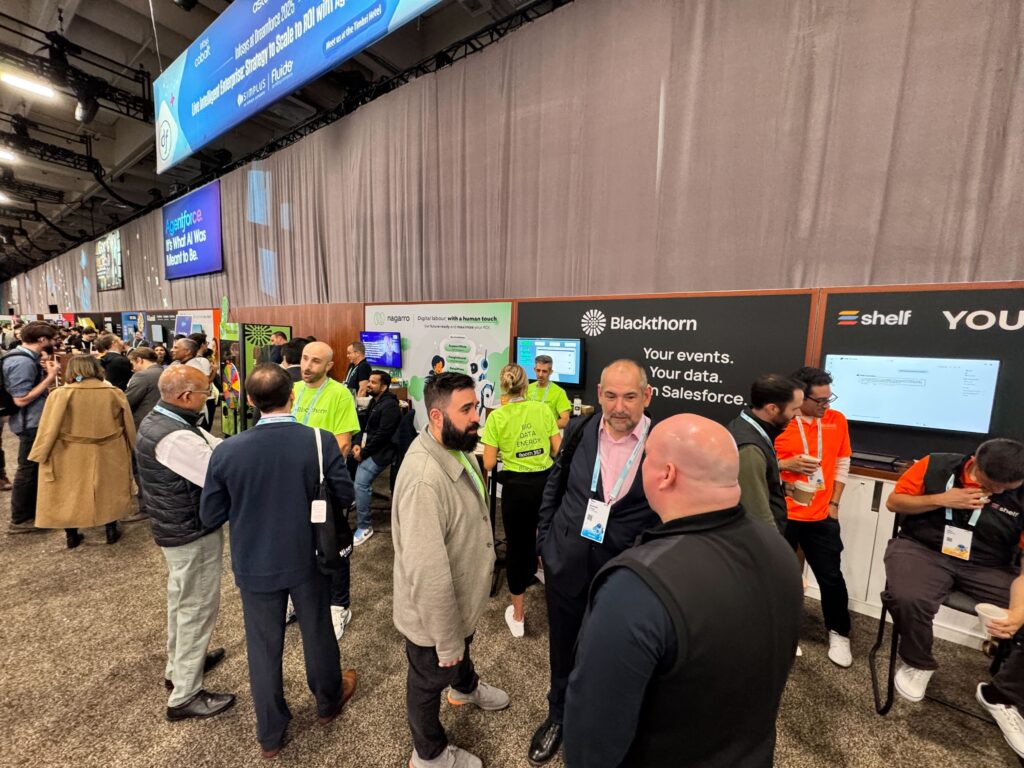
Updated monthly with real observations from the events the Blackthorn team attends and sponsors — not polished takeaways, just what we’re actually noticing on the ground.
Blackthorn’s experience in August 2026
- Audience fit matters more than topic fit. Before sponsoring anything, check who’s actually going to be in the room, not just what the agenda promises. We recently attended an event where most attendees were senior decision-makers focused on budget and strategy rather than day-to-day implementation. It was a good event, just the wrong fit for us.
- AI fatigue is showing up even as AI budgets grow. Several vendors leaned hard on AI branding this month. Even while their own leadership still wants to see AI somewhere in a pitch to approve budget, event attendees and practitioners seem fatigued by the fact that AI is listed all over the marketing materials. “How to” sessions built around real implementation details and honest case studies pulled bigger, more engaged crowds than sessions built around AI messaging alone.
- Swag still works, if it’s useful. Practical items, think stain-fighting pens and notebooks, got picked up far more than novelty gadgets at conferences this month. Match giveaways to what your specific audience will actually use, not what looks cool on the table.
The New Event Industry Trends Landscape: What’s Changing in 2026
1. Smaller budgets? Not exactly. Just smarter allocation.
Most organizations aren’t cutting event budgets. They’re redistributing them. Industry research backs this up: in American Express Global Business Travel’s Global Meetings and Events Forecast, the majority of meeting professionals expect their budgets to grow this year, even as the average cost per attendee climbs. Leaders want every dollar to drive pipeline, applications, donations, membership, or mission outcomes, not just stage design or headcount.
Budgets are still healthy, and planner confidence backs that up. Roughly 85% of planners report feeling as optimistic about the industry as they did the year before, according to Northstar Meetings Group’s industry pulse survey. But scrutiny is sharper. Planners who can connect spend directly to measurable outcomes will win support (and budget) faster.
2. The rise of the regional event portfolio
The mega-conference isn’t dead, but it’s no longer the centerpiece of most strategies or event industry trends.

Smaller, regional gatherings offer what attendees consistently say they want:
- More meaningful access to subject-matter experts
Easier travel - Interactive formats where they can participate, not just observe
- Authentic, local experiences
These “micro-events” produce deeper engagement at a fraction of the cost and are easier to personalize, measure, and scale.

The numbers back up what attendees are asking for. In 2024, 54% of planners most frequently booked events of 250 people or fewer, and 90% of planners say they’re considering secondary markets, lower-cost cities with strong infrastructure, for cost savings and a better fit for attendees. On the attendee side, 75% say they want connections that broaden their perspective, 63% value direct access to subject-matter experts, and 51% say strong networking alone is reason enough to attend.
This is also driving a related shift: ‘destination dupes.’ Instead of booking the highest-prestige city on the list, planners are choosing regional hubs with a similar vibe and strong infrastructure at a fraction of the cost, think Austin instead of San Francisco, or Charlotte instead of New York.
For a deeper dive, read:
Small Events vs Large Events: Why Regional Strategies Win
3. AI is part of the infrastructure
AI is now woven throughout the event lifecycle, but not in the “let AI do everything” way many expected in event industry trends.
The winning teams use AI to accelerate personalization, drafts, segmentation, and analysis while preserving a human touch in voice, tone, and relationship-building.
AI is now:
- Drafting content (agendas, abstracts, summaries)
- Personalizing outreach
- Scoring attendees
- Predicting interest and engagement
- Supporting real-time recommendations
The teams seeing the biggest lift are the ones who use AI to scale human strategy, not replace it.
The differentiator isn’t speed, it’s editing. Teams getting the most out of AI use it to produce a fast first draft, an agenda outline, an email, a session abstract, then spend their saved time on the parts AI can’t do: curated roundtables, peer labs, and personalized follow-ups. Track it the same way you’d track any efficiency gain: time to publish, hours saved, and how much staff capacity shifts toward higher-value work instead of drafting.
Deep dive resource:
The Ultimate Guide to AI-Driven Event Marketing Personalization
4. Attendees expect personalized messaging

Generic email blasts are no longer enough to move attendees from registration to attendance to action.
Organizations are shifting to:
- SMS
- RCS
- In-app notifications
These channels cut through inbox clutter and deliver 10x higher engagement, making them essential for:
- Reducing no-shows
- Clearing waitlists
- Driving session attendance
- Accelerating follow-up actions
In healthcare specifically, this isn’t just an engagement tactic, it’s a measurable cost fix. SMS reminders have been shown to reduce no-shows by 20 to 40% across care settings, according to multiple studies of automated reminder programs. The same logic applies across industries: a morning-of reminder, an instant waitlist-clearance text when a session opens up, and a personalized ‘save your seat’ follow-up after the event all outperform a single batch email sent to everyone at once, regardless of what they actually attended.
5. Too many event tech tools negatively affect pipeline

Events have shifted from logistical undertakings to strategic growth channels. That shift created new demands: seamless integration with CRMs and marketing systems, compliance with payment and accessibility rules, and proof of ROI through attribution data. Meanwhile, the event tech marketplace has exploded, with platforms for registration, payments, messaging, and analytics often living in silos. Without a coordinated approach, teams face inefficiency, manual workarounds, and data blind spots.
You may not need to hire a dedicated Event Technologist, but you do need a tech stack that works. The goal is a single ecosystem that covers registration, payments, messaging, check-in, compliance, attribution, and reporting without the friction of CSV exports or disconnected tools.
Try this:
- Establish clear SLAs for data hygiene, attendee matching, and follow-up speed.
- Audit your current stack to identify redundancies and manual processes.
- Standardize tools that reduce the number of exports and imports.
- Prioritize platforms that can manage registration, payments, messaging, compliance, and reporting in one ecosystem.
This shift reduces friction, eliminates manual exports, and gives leadership measurable ROI tied directly to pipeline, deposits, gifts, or citizen engagement.
This is also fueling a new role: only 24% of organizations currently have a dedicated Event Technologist, but 82% expect the role to grow in importance over the next five years. Most sit inside the planning team today, with the rest spread across operations, IT, and marketing. You don’t need to hire one to benefit from the mindset: audit your current stack for redundant tools and manual exports, and prioritize platforms that can handle registration, payments, messaging, compliance, and reporting in one place.”
To understand whether you need a dedicated Event Technologist or simply a smarter stack, read:
Do I Need an Event Technologist or Just Smarter Event Tech?
6. Business leaders Want More Data-Driven Proof

Leadership is no longer satisfied with registrations or badge scans — they want proof that events drive real business and mission outcomes. For some, that’s pipeline and deal acceleration; for others, it’s deposits, gifts, or CME credits. In the public sector, it can even mean building citizen trust. For example, when a city hosts a community forum and residents leave feeling more confident in their local leaders and more willing to engage in civic programs. The metrics have to change because the expectations have: events are now judged by how directly they advance revenue, engagement, and impact goals.
Try this:
- B2B: Pre-book solution consults, run in-booth trials, and schedule account-based networking sessions.
- Financial Services: Host portfolio review sessions, client education events, and small-group strategy roundtables.
- Higher Ed: Track admit-day attendance and tie directly to deposits/enrollment.
- Healthcare: Pair CME credit tracking with on-site educational workshops.
- Public Sector: Measure citizen engagement through transparent accommodation requests and follow-up surveys.
- Nonprofit: Host donor appreciation events, share impact stories live, and create exclusive giving-circle experiences.
7. Interactive Events Become the New ROI Engine

Attendees are no longer satisfied with passive, one-way presentations. They’re looking for connection and clarity. They want to test, experiment, and interact directly with content and each other. Experiential sessions improve retention and create stronger emotional connections, which is critical at a time when attention spans are short and events compete with digital alternatives. The formats that stand out are those that invite attendees to co-create knowledge rather than just absorb it.
Try this:
Replace some long-form keynotes with interactive formats that balance learning and doing. Examples include:
- Solution labs where attendees try out products or workflows in guided, real-world scenarios.
- Bring-your-data clinics where prospects receive tailored advice using their own datasets.
- Executive office hours or “Ask Me Anything” circles that provide access to leadership in small-group settings.
- Peer-to-peer idea swaps where participants trade best practices on specific challenges.
- Gamified workshops that use role play or live challenges to reinforce takeaways.
The biggest shifts:
- 74% say in-person events are the best way to evaluate solutions
- Networking remains the #1 driver of event satisfaction
- Hands-on, participatory formats outperform passive sessions
The fastest-growing shift across all sectors — corporate, higher ed, nonprofit, healthcare, financial services, and public sector — is the movement from passive attendance to active participation.
Interactive formats such as:
- Hands-on labs
- Peer roundtables
- Bring-your-data clinics
- Executive office hours
- Topic-match networking
- Real-time polls and Q&A
- Personalized SMS journeys
…aren’t just more engaging. They produce measurable impact:
- Higher participation → higher retention
- Real-time interaction → better data
- Human connection → stronger conversion
Interactive events don’t just “feel good” — they perform better.
Breakdown of these tactics:
6 Interactive Strategies to Improve Event ROI
Want the Full Breakdown of Event Industry Trends?
This article covers the high-level trends, but the complete report includes:
✔ All nine “What’s Out / What’s In” event industry trend shifts
✔ Actionable plays for Corporate, Higher Ed, Nonprofit, Healthcare, Public Sector & Financial Services
✔ Measurement models for ROI across industries
✔ Real-world examples and event benchmarks
✔ How to execute each trend using Salesforce-native technology
👉 Download the full guide:
Event Industry Trends: What’s Out, What’s In, and How to Stay Ahead
Ready to stop juggling tools and start running smarter events?
Schedule a demo and see how Blackthorn works inside Salesforce.