A trillion-dollar industry is quietly undergoing a structural reckoning. Events have moved from marketing line items to revenue infrastructure — and the technology stack underneath them hasn’t kept up.
The U.S. events market alone reached roughly $285 billion in 2024. Organizations aren’t scaling back. According to the 14th Annual Global Meetings and Events Forecast from Amex GBT, which surveyed more than 500 meetings and events professionals across 26 countries, 66% expected their budgets to grow in 2025, and 74% are optimistic about the industry’s trajectory. Events are expanding in every direction — in-person flagships, virtual programs, hybrid formats, always-on calendars — touching every part of the business, from pipeline and partnerships to donor engagement and retention.
But investment alone doesn’t guarantee progress. Freeman’s Event Organizer Trends research found that 73% of event programs remain stuck in the past, unchanged despite a workforce and attendee base that has fundamentally shifted. More money is flowing in, but the operating model underneath hasn’t kept up.
This article is drawn from our Blackthorn Boost keynote, where we shared our vision for the next chapter of Salesforce-native event management — foundation, accessibility, and intelligence in action. Watch the full session →
The Infrastructure Problem Blocking Event ROI
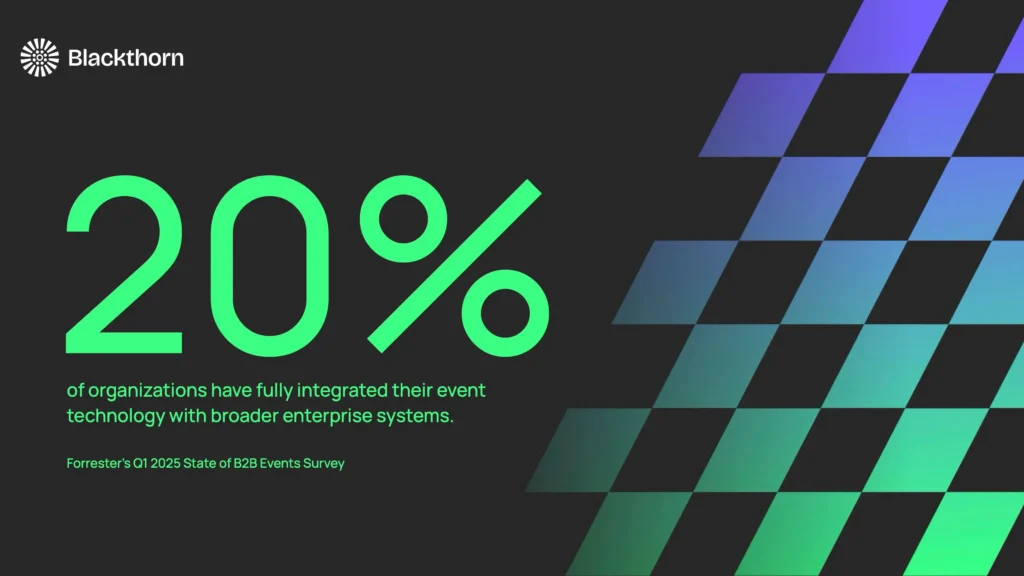
Most event teams are still running on a patchwork of disconnected tools, manual spreadsheets, and post-event reporting that arrives weeks too late to influence anything. Attendee data lives in one system. CRM logic lives in another. Attribution gets stitched together after the fact by someone who should be focused on strategy. Forrester’s State of B2B Events research found that only 20% of organizations have fully integrated their event platform into their sales and marketing stack.
That’s the gap at the center of modern event management — and closing it requires more than a better landing page or a faster check-in app.
Events are revenue infrastructure. It’s time to build them that way.
For organizations that run on Salesforce, the foundation already exists. The question is whether your event program is truly built on it — or just connected to it. That distinction matters more than most teams realize, and it’s reshaping how forward-thinking event leaders think about technology, data, and scale.
This expansion has also changed who owns events. They’re no longer managed by a single team with a single budget. They now touch every part of the organization — from those responsible for pipeline and outreach to those accountable for operations, reporting, and outcomes. More stakeholders are involved, more formats are in play, and more is riding on the results.Our own Event Planning Trends Report reflects this shift: event leaders today are prioritizing clearer performance visibility, less operational drag, and scalable processes that hold up across formats and teams. The demand is there. The question is whether the infrastructure underneath can meet it.
Why “just connect it to Salesforce” isn’t enough
The event tech industry has a ready answer to the infrastructure problem: connect your event platform to Salesforce. Sync attendee data. Push registrations into campaigns. Problem solved.
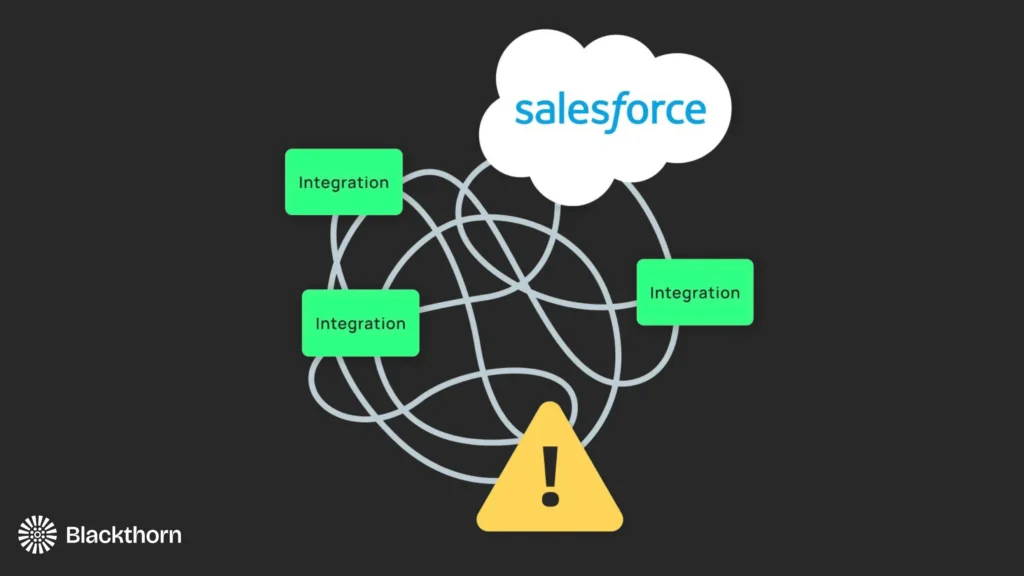
In practice, it rarely works that cleanly. Salesforce isn’t just a database you plug into — it’s a platform organizations build on. Deeply customized, constantly evolving, and central to how the business operates. Every company configures it differently: custom objects, unique campaign structures, complex attribution models, territory rules, automation flows.
When your event system lives outside that architecture — even if it “syncs” — it operates adjacent to the business instead of inside it. Data may transfer, but context gets lost in the process. Attendee activity pushes over, but downstream reporting still requires manual interpretation. Someone still has to validate it, map it, and reconcile it.
That’s not integration. That’s a workaround. And workarounds create a strategic ceiling: when insight arrives late, strategy reacts late.
Foundation first. Experience second.
For organizations that invest in Salesforce as their platform, a native approach doesn’t just improve reporting — it unlocks an entirely different operating model.
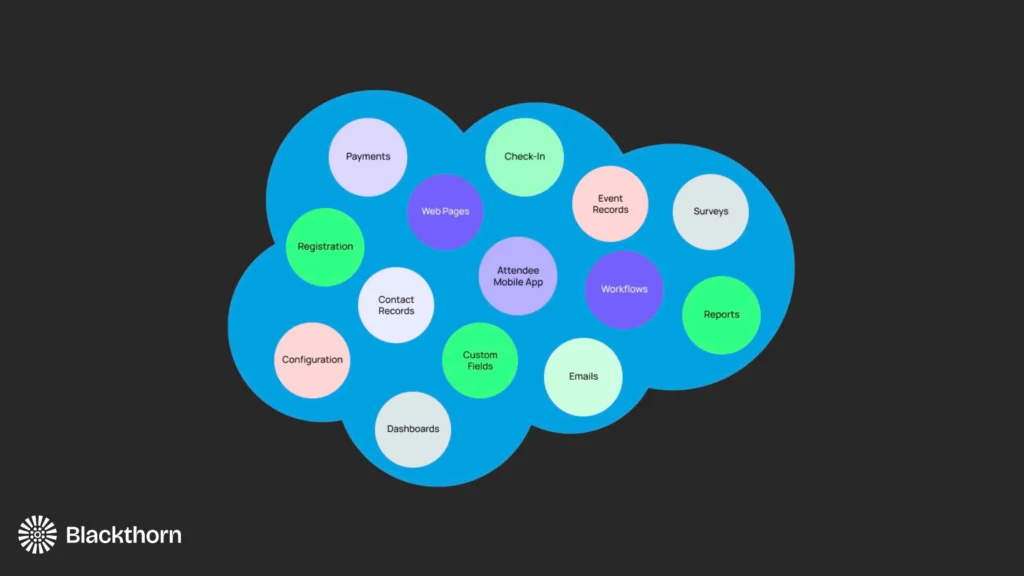
When event data lives where the business already runs, teams gain a unified engagement history across every touchpoint, clearer attribution tied to real outcomes, and real-time visibility without exports or reconciliation.
But there’s a second half to this equation that often gets overlooked. Anyone who has worked as a Salesforce admin knows its complexity. For event planners running programs day-to-day, that learning curve stalls adoption and limits who can participate. Salesforce should remain the engine — but the experience built on top of it has to evolve.
The future of Salesforce-native event management isn’t just about keeping data in Salesforce. It’s about making execution accessible enough that event programs can scale beyond a single power admin.The next chapter: accessibility, intelligence, and impact at scale
With the right foundation in place, the question shifts from whether events can live in Salesforce to how they should operate.
The next era of Salesforce-native event management will be driven by three shifts: accessibility, intelligence, and impact at scale.
These aren’t feature upgrades. They’re operational upgrades.
1. Accessibility at scale
If events function as revenue infrastructure, they cannot rely on a single specialist to configure and manage everything.
Running events should feel intuitive without sacrificing capability. The Salesforce Foundation ensures unified data, while accessibility enables more people to use it easily.
When more team members can participate, more programs can launch, and more experiences can run without bottlenecks. That’s how event portfolios grow without growing operational drag.
2. Intelligence in motion
Salesforce provides the foundation for data, but teams need insight throughout the event process — not after it’s over.
Teams should be able to understand:
- What engagement is driving outcomes?
- Which registrants (and eventually attendees) are most likely to take the next step?
- Where does follow-up need to happen?
- How are events influencing broader goals?
When teams unify event engagement data, they generate immediate insights and drive faster, more accurate reporting, automation, and decisions. This changes how fast teams can move and how confidently they can lead.
3. Impact that compounds
Accessibility removes bottlenecks. Intelligence removes guesswork. Together, they turn events from isolated moments into connected experiences that influence revenue, donations, enrollment, and long-term engagement — and prove it.
What this means for event leaders on Salesforce
If Salesforce is your system of record, the strategic questions right now should be:
- Is your event data native — or merely connected?
- Can more than one person run events confidently?
- Do you have insight while decisions still matter?
- Are you measuring real outcomes — or just registrations?
The organizations that extract the most value from events don’t treat them as campaign add-ons. They’ll treat them as infrastructure for the business, built on connected data, designed for scale, and measured with clarity.
Teams that architect for that future today will define event strategy for the next decade.
Over the coming weeks, we’ll be sharing even more details about the next chapter of Salesforce-native event management and why it matters to your organization. Stay tuned!
At Blackthorn Boost, we shared our first look at the next era of Salesforce-native event management — and how foundation, accessibility, and intelligence come together in practice. The full virtual event is now available on demand.
Ready to stop juggling tools and start running smarter events?
Schedule a demo and see how Blackthorn works inside Salesforce.